How Inclusive Leadership and Strategic Redesign Can Support Sustainable Careers After 35
Prelude: Reflections from SHRM25
At the SHRM25 Annual Conference, themes like human presence, sustainable leadership, and future-proofing careers echoed across sessions. One message emerged loud and clear: career systems are breaking down not just at retirement, but far earlier — for professionals in their late 30s and early 40s. This inflection point demands a deeper look into how organizational systems support (or fail) mid-career talent, particularly as AI-generated content (AIGC, referring to generative artificial intelligence that produces text, code, images, or multimedia using deep learning) reshapes how work is performed, evaluated, and sustained.
As a SHRM Global Instructor and dual-certified professional (SHRM-SCP and ATD CPTD), as well as an official CPTD test item writer and reviewer, I’ve witnessed first-hand the structural misalignment between career realities and system responses. Across markets and milestones, I’ve seen too many capable professionals — deeply committed, still growing — being quietly pushed out. Not because they’ve lost their edge, but because their value doesn’t fit a youth-optimized, output-maximized system. When experience becomes inconvenient, we have a system problem. — not because they’re no longer capable, but because the system isn’t built to value or extend their contributions beyond the early peak.
Global Trends vs. Structural Lag
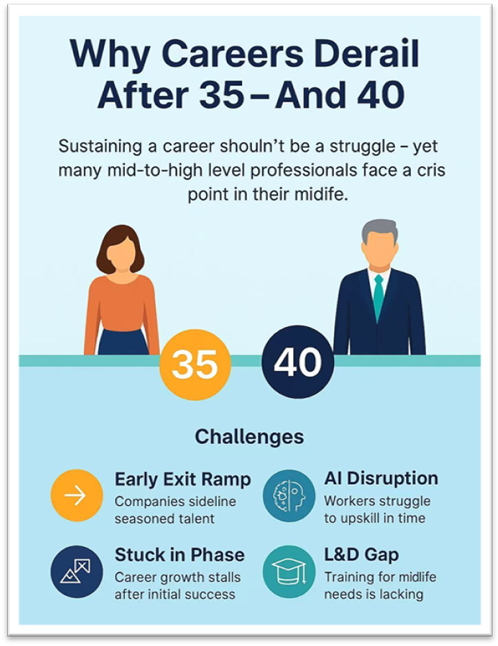
According to the Organisation for Economic Co-operation and Development (OECD), the effective retirement age in developed economies is now over 64 for men and 63 for women, and rising. Yet in cities once celebrated for their dynamism — particularly across Asia — professionals are now expected to peak by 35 and fade out by 40. That’s not strategy. That’s systemic short-sightedness dressed up as efficiency. or forced transitions as early as 35 to 40. Phase retirement, a concept tied to flexible, extended workforce engagement, is virtually absent in many high-efficiency labor markets.
Reports from Generation.org and Apollo Technical reveal that nearly 40% of the Organisation for Economic Co-operation and Development (OECD) workforce is aged 45–64, with the average career switch occurring at age 39. These individuals still have decades of cognitive, leadership, and mentorship value. However, in some fast-growth cities, workforce models remain extractive: built to accelerate young labor and quietly retire experienced professionals with limited structural support.
AIGC: Disruption or Career Catalyst?
Recent insights from Indeed Hiring Lab and academic preprints like the 2ACT framework (AI-Accentuated Career Transitions, a conceptual model describing how AI reshapes skill relevance and career movement) suggest that AI isn’t just replacing roles — it is also redefining the skills, expectations, and transitions tied to mid-career professionals. AIGC intensifies the pace of change, disproportionately affecting workers aged 35–54. Yet, when paired with cognitive-rich work and intentional upskilling, it can act as a bridge into renewed career relevance.
This dual role of AI — as both threat and amplifier — makes career system redesign urgent. We must ask: how do we build infrastructures where second-curve careers are not only possible, but strategically nurtured?
SHRM’s Learning & Development Lens
SHRM’s own Body of Applied Skills and Knowledge (BASK) situates Learning & Development (L&D, the strategic function within HR focused on improving individual and organizational capabilities) at the heart of people systems. As emphasized in SHRM’s SCP/CP materials:
- “Development is future-focused, while learning supports performance today.”
- Leadership buy-in, a supportive learning culture, and strategic alignment determine the success of L&D systems.
Too often, organizations overinvest in early-career development and neglect mid-career scaffolding. A sustainable system requires:
- Reframing L&D architecture: Use the 70-20-10 model to shift learning from courses to experience — peer coaching, cross-functional stretch roles, and internal mobility can anchor renewal.
- Designing visible second-curve tracks: Career paths post-40 should not rely solely on managerial promotion. Expert tracks, portfolio roles, and advisory leadership must be formalized.
- Integrating AIGC into upskilling: Generative AI tools are not just technical — they shape communication, strategy, and execution. Making them core to L&D offerings keeps mid-career professionals system-relevant.
Why This Matters Now
Without structural redesign, even high-performing professionals are left vulnerable — not due to lack of ability, but because the system never imagined their continued value. In parts of the world where labor models still equate age with declining output, the cost is not just personal — it is institutional. Lost tacit knowledge, mentoring gaps, and cultural continuity failures become unavoidable.
Yet I remain optimistic. The SHRM community — especially SHRM NYC — isn’t just a bystander. We’re capable of being catalysts. We can model what it means to value lived experience, to make space for evolution, not just onboarding. by surfacing and sharing frameworks that enable career reinvention.
What You Can Do (Actionable Steps)
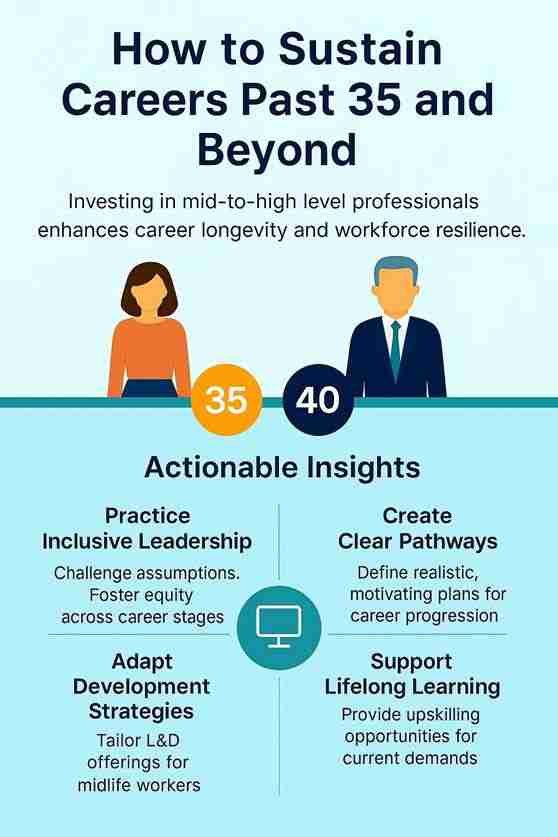
- Practice Inclusive Leadership Systemically
Train leaders to challenge age-related assumptions, foster intergenerational equity, and ensure all career stages are seen, heard, and valued. - Audit your career architecture: Is there a path beyond age 40 that doesn’t require title inflation? If not, redesign it.
- Champion mid-career case studies: Tell success stories internally of second-curve transitions — this normalizes later-stage evolution.
- Reallocate L&D budgets: Ensure at least 30–40% of development funds support the mid-career cohort.
- Use AIGC intentionally: Offer tools that enhance — not replace — human judgment. Start with job-specific co-pilots, AI-supported coaching, and adaptive content.
Closing :
Mid-career isn’t an ending. It’s a second beginning — if the systems surrounding it allow for one. In an age of AIGC and shifting demographics, sustainability isn’t just environmental. It’s professional. And now is the time to reimagine it — curve by curve.
Data Sources and References:
- OECD Employment Outlook 2023: Effective Retirement Ages and Workforce Aging
- Generation.org Global Workforce Report (2022–2024)
- Apollo Technical: Mid-Career Transition Trends and Digital Skills Gap
- Indeed Hiring Lab: AI and Labor Market Trends in Mid-Career Roles
- 2ACT Framework: AI-Accentuated Career Transitions (Preprint, 2024)
- SHRM BASK Model and L&D Competency Framework (2023)
Author Bio:
Maggie Sun is a SHRM Global Instructor, SHRM-SCP and CPTD dual credential holder, and an ATD CPTD test item writer and reviewer. She advises Fortune 500s, public sector leaders, and SME executives on global talent strategy, learning architecture, cognitive leadership development, and enterprise transformation — with a focus on reorganization and systemic alignment.